
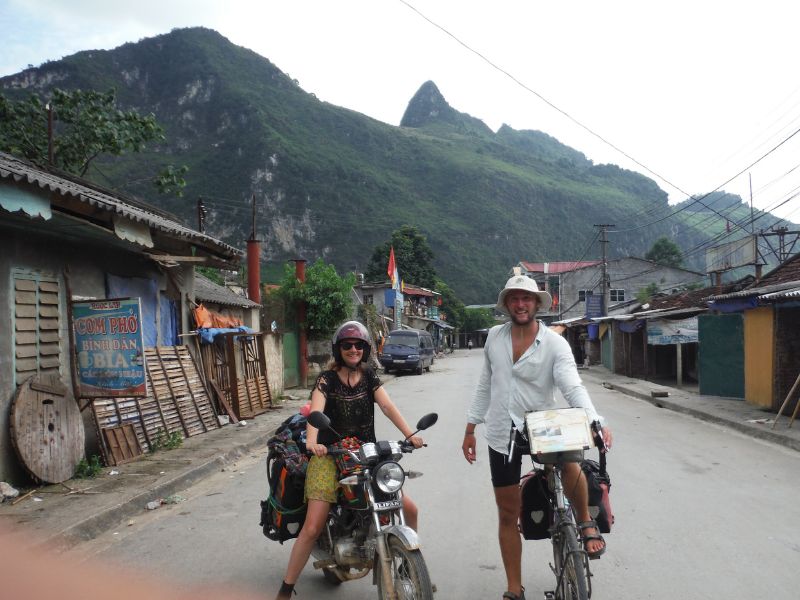
I once journeyed to Vietnam to meet an old flame. Turns out there’s more to choosing a bike touring companion than money in the bank and a desire to travel.
TL;DR: Bike Touring Companions
- Long distance bike travel does not create problems. It reveals them.
- Fitness matters. But shared values matter more. You can pace legs. You cannot pace mismatch.
- Align early on the big stuff. Risk tolerance, money, comfort standards, daily rhythm, decision making.
- The road rewards simple habits. Clear communication, kind tone, quick repairs after conflict.
- Do a short test ride before a big commitment. Bad weather is the best teacher.
- If you want the best touring partner, look for trust, flexibility, and fairness. Not just speed.

That Moment When You Realise It’s Not Working
There is a moment on every long-distance ride when the noise disappears. It might arrive
halfway up a mountain pass, somewhere between exhaustion and awe, when the only sounds
are your breath and the hum of tyres on tarmac. These are the moments that remind you why
you chose the road in the first place.
But if you have ever travelled with the wrong companion, you will know that even the most
spectacular landscapes cannot compensate for misaligned expectations. Overland travel has a
way of amplifying personality traits. Patience, resilience, curiosity, and adaptability quickly
rise to the surface when plans unravel or conditions shift.
For many riders today, preparation is no longer limited to route planning and gear lists. Choosing a suitable bike touring companion to travel with has become just as intentional. This travel research also finds that compatibility and smooth communication with companions strongly shape the experience.
READ: That time I travelled halfway across the world to meet The Girl With The Super Niche
The New Era of Intentional Travel Companions
Adventure travel once relied heavily on chance encounters in hostels, roadside cafés, or
border crossings. While those spontaneous meetings still happen, many riders now prefer to
begin long journeys with people who already share similar outlooks and values.
Digital platforms have quietly become part of that process. Some cyclists use them to find
riding partners, others to stay connected across borders, and some to build relationships that
may later translate into shared journeys.
One example is SALT, a global Christian dating and community platform available in more
than 50 countries and translated into 20 languages. Built by Christians and run by a small,
dedicated team, the platform places faith and values at the centre of connection, rather than
treating them as secondary filters. For riders planning weeks or months on the road, that kind
of alignment can make a tangible difference.
Inspiration:
Compatibility Goes Beyond Fitness
Two people can be equally strong riders and still be incompatible travel companions. Long-
distance cycling exposes differences in risk tolerance, decision-making, communication style,
and emotional resilience.
SALT allows users to highlight values, personality traits, and interests through profile badges,
offering clarity before a conversation even begins. Instead of discovering major differences
halfway through a remote stretch of road, travellers can establish shared priorities early.
The platform also supports voice notes and in-app video calling, tools that allow people to
build familiarity before committing to shared itineraries. Hearing how someone thinks
through a challenge or reacts to uncertainty can reveal far more than text alone.
For riders who prefer directness, the ability to see who is online now and send intro messages
before matching helps conversations start naturally, without delay or ambiguity. The Cycle Touring Companions Group shares this belief and helps connect likeminded bike travellers.
Community Still Matters on the Road
Despite the romantic image of the lone cyclist, most long-distance riders rely on community.
Whether it is shared meals, borrowed tools, or advice passed along a roadside conversation,
human connection remains central to the experience.
SALT reflects this through a built-in social feed, where users engage beyond one-to-one
conversations. Riders can exchange ideas, reflect on experiences, and remain connected even
while moving between countries.
The platform also hosts live audio discussions called Table, covering topics such as travel, mental health, faith, and relationships. These conversations often resemble the thoughtful exchanges that happen around campfires or over simple meals after long days in the saddle.
Importantly, the app offers a fully functional free version, allowing people to message, meet,
and connect without barriers, while Premium options simply provide additional flexibility.
Trust on Long Roads
Long journeys require trust. When the nearest town is hours away and plans change unexpectedly, you depend on the people beside you.
Choosing companions who share your values reduces friction and builds confidence in difficult moments.
Platforms that emphasise clarity, community, and intentional communication can support that
process. They do not replace the road, but they can shape who joins you on it.
Riding Further, Together
Long-distance cycling teaches you that progress is not only measured in kilometres. It is
measured in understanding, cooperation, and shared purpose. When riders move with aligned
values, the journey becomes lighter, even when the terrain is not.
Whether a connection begins at a roadside café or through a digital conversation, what
matters most is not how it starts, but how well it carries you forward. Shared values do not
guarantee an easy ride, but they often make it a meaningful one.
FAQs: Shared Values and Choosing Bike Touring Companions
What makes a good bike touring companion?
A good touring companion is someone you can trust when things go wrong. They can communicate clearly. Stay kind under stress. Compromise without keeping score. Research on “ideal travel partners” often points to traits like emotional intelligence and compatibility, not just experience or ability.
Do shared values matter more than fitness on a long ride?
Often, yes. Fitness can be managed with pacing and rest days. Value clashes usually get worse over time. If you disagree on risk, money, daily routine, or how decisions get made, the road will expose it fast.
What values should touring partners align on?
Start with the big four:
- Risk tolerance. How safe is safe enough?
- Daily rhythm. Early starts or slow mornings?
- Comfort standards. Wild camping or hotels?
- Decision making. One leader, or shared calls?
If these match, most smaller issues become manageable.
How do we avoid pace and fitness arguments?
Talk numbers before you ride together:
- target daily distance range
- climbing style. Grind or walk?
- rest day frequency
- “no shame” rules for bad days
A short test trip reveals more than a long debate.
What should we discuss before committing to a long tour?
Use this pre tour checklist:
- budget and spending habits
- sleep expectations
- food preferences
- navigation responsibility
- boundaries. Solo time, social time
- what happens if one person wants to quit
Most conflicts come from assumptions, not disasters.
How do we handle disagreements on the road?
Agree on a simple conflict rule before you leave:
- pause and eat something
- state the problem in one sentence
- offer two solutions each
- pick one and move on
In group settings, open and respectful communication is consistently linked with better coordination and trust.
How important is trust on a remote route?
It is everything. When the next town is hours away, you need to trust your partner’s judgement and intentions. Trust reduces friction. It speeds up decisions. It keeps small mistakes from turning into big drama.
Should touring partners share the same travel style?
Not perfectly. But you need compatibility on the non negotiables. If one person wants spontaneous detours and the other needs structure, you can still make it work. You just need a plan for how decisions happen in real time.
Is it better to tour with friends, a partner, or strangers?
There is no universal best. Friends can carry old patterns into stressful moments. Couples can struggle if roles feel unequal. Strangers can be great if expectations are clear from day one. What matters is alignment and communication, not the label.
How can couples avoid conflict when bikepacking or touring together?
Keep it simple:
- rotate responsibilities. Navigation, cooking, logistics
- build in solo time
- do a daily check in. Ten minutes max
- separate effort from emotion. A bad day is not a bad relationship
Bikepacking advice for couples consistently comes back to communication and adaptability.
What are the biggest red flags in a touring companion?
Watch for these early:
- refuses to discuss money
- blames others for problems
- gets angry when tired or hungry
- ignores safety concerns
- never compromises
- turns every decision into a debate
A touring partner does not need to be perfect. They do need to be fair.
How do we set boundaries on a long distance ride?
Say it out loud before you leave:
- when you want quiet time
- what you share and what you keep private
- how you handle social media and photos
- what support you expect on hard days
Boundaries prevent resentment. They also protect the friendship.
How do we decide who leads on route choices and safety calls?
Pick one of these systems:
- Captain of the day. One person leads, it rotates daily.
- Two yes rule. Both must agree for a risky option.
- Veto rule. Either person can veto a safety decision.
This removes heat from the moment. It makes decisions faster.
Can apps help you find more compatible touring companions?
Yes, if you use them to filter for values and communication style, not just cycling ability. Platforms that help people talk properly before meeting can reduce surprises later, especially for long trips.
What should we do before booking flights or committing to months on the road?
Do a short “pressure test” first:
- a weekend overnighter in bad weather
- a day with big climbs
- a navigation day where you swap roles
- a night when the plan changes late
If you stay kind through that, you are probably fine for the longer ride.